Designing experience to help users build reading habits and a reward program to generate retention and meaningful incentive for the users.
The challenge
Despite understanding the importance of reading for personal and professional growth, many individuals struggle to develop consistent reading habits due to hectic schedules and everyday distractions. A lack of clarity about the benefits and perks of reading is a key reason why so few individuals cultivate this habit.
Why this is actually a problem?
The struggle to build reading habits is rooted in psychological and behavioral challenges. Research indicates that:
Cognitive Overload: Users often feel overwhelmed by the sheer volume of choices available,leading to decision paralysis.
Lack of Immediate Gratification: Traditional reading does not offer instant rewards, making it difficult for users to stay motivated.
Competing Digital Distractions: With the prevalence of social media and other digital content, users are easily sidetracked from their reading goals.
These factors contribute to a cycle of under-engagement, resulting in users purchasing fewer books and ultimately harming the sustainability of platforms like Booktron.
My Role
I contributed as the Product Designer ( User Experience (UX) and User Interface (UI)) for this project. Research analysis and constructive architecture was also accomplished under my role play.
Our goals
1.
Nudge users to read on daily basis
Getting users to read daily fosters consistent habits, boosts engagement, enhances cognitive growth, and ensures sustained app retention and sales
2.
A reward or loyalty program
Create a reward program for Booktron to generate retention and a meaningful incentive for the users.
User Interview
The interview sample took into account people as students and working professionals among which some are totally involved in reading and some are not so; precisely - interviewed audience had different reading habits. he included topics to get to the core of what users are trying to do and what their problems are. So I asked:
• What are your reading habits.
• Where do you get your content from.
• What products do you use for reading.
• What kinds of incentives would make you read more.
User insights
After analysing the interviews, despite the amount of generated data, this was the most relevant information for decision-making in creating the solution:
90%
Believe that reading makes them a reference to their friends & profession.
Users value transparency and control. Communicating filter adjustments clearly and offering actionable alternatives enhanced trust and usability.
50%
Prefer reading digital median than physical books for convenience.
76%
Struggle to build reading habits
60%
Want to become a reference in their profession.
What we see is that although 90% of users understand that increased content consumption wouldhelp them become an expert in their profession, more than 70% of them said they find it very difficult to create healthy reading habits.
Desk research
To inform our design decisions, we conducted extensive secondary research, utilizing platforms like Consensus and SciSpace. In addition, I researched data and habits related to other current Loyalty Programs. The goal was to understand how competitors behave and benchmark innovative reward programs.
I analyzed major platforms which offers loyalty or reward functionality

Reading Frequency: According to a study by Pew Research, only 27% of adults read more than 10 books a year, highlighting a significant opportunity for engagement.
Motivational Factors: A survey conducted by the National Endowment for the Arts found that 62% of adults reported they would read more if they had a structured program or incentives in place.
Behavioral Insights: Research from the University of Southern California indicates that incorporating gamification elements, such as rewards, can significantly increase engagement in habitual activities.
These insights validated the need for a loyalty program to incentivize reading.
Setting out to achieve our goals!
Overarchingly, I designed the whole BookTron app including the eBook ecommerce system, payments and etc. However, for this case study I have focused on Reward and reading mechanism system.
Introducing Brainbox
Booktron’s loyalty program that not only gives you points by shopping, but also rewards you for developing reading habits, encouraging you to become a genius in your area of interest.
About Brainbox
Brainbox is booktron’s reward program. Its value proposition is to offer daily and weekly triggers to get the user to develop a reading habit and return daily to the app resulting in increase in user retention.
So, how do I earn points?
Users earn 1 point for completing a daily reading task of 10 minutes, with a limit of 1 point per day to encourage consistent engagement.
Bonus points are awarded when users complete 7 consecutive days of reading, earning an additional 5 points to reinforce long-term commitment.
A standard bonus system is implemented, where users earn 1 point for every $1 spent on book purchases, providing a way to engage users who may not yet have a strong reading habit.
This purchase-based points system serves as a gateway, encouraging users who buy books to start engaging with the app more consistently, even if they haven't yet developed a regular reading routine.
How do I redeem my points?
For every 50 points earned, users receive a 5% discount on their next purchase.
At 75 points, users unlock a 10% discount on their next purchase.
At 100 points, users earn a 15% discount on their next purchase.
The first points are designed to be easier to earn, with users able to accumulate enough points through a 10-minute daily reading habit to qualify for at least a 5% discount within the first month.
Now comes the In-app book reading interface
As we wanted to nudge users to read daily and get rewarded we were also transitively focusing on increasing the user retention by increasing the time spent rate of Booktron.
We created a slick reading experience to give our users the ground of physical book!
Book reading interface video probably with curl effect
Our hypothesis for pushing users to read daily
Integrating a 15-minute reading tracker with automatic notifications for users when they achieve their daily goal will reinforce a consistent reading routine, encouraging regular engagement with the app and helping users form lasting reading habits.
Validating our hypothesis with rationale
User Engagement in Short Bursts: The study "Improving Reading Comprehension Skills through Short Stories" shows that engaging in short bursts of activity, such as 5-15 minute sessions, can be highly effective for reinforcing habits.
Attention Span Considerations: The human attention span tends to decrease during longer tasks. Short sessions are more manageable and allow users to focus without distraction, making it easier for them to complete the goal. Findings from "Chapter Four: Literacy, Focused Attention, and Contemplative Practice" supports the idea of using brief reading sessions to maximize productivity and this approach can work across different demographics.
Psychological Impact: The study "Teaching the Short Story to Improve L2 Reading and Writing Skills" shows that completing short, engaging tasks helps learners feel accomplished and taps into the psychology of reward and reinforcement, which increases the likelihood of users returning to the app.
Key validation: Incorporating a 15-minute tracker and positive reinforcement can thus effectively support habit formation and improve user retention by making the reading process more accessible and rewarding.
User Flow
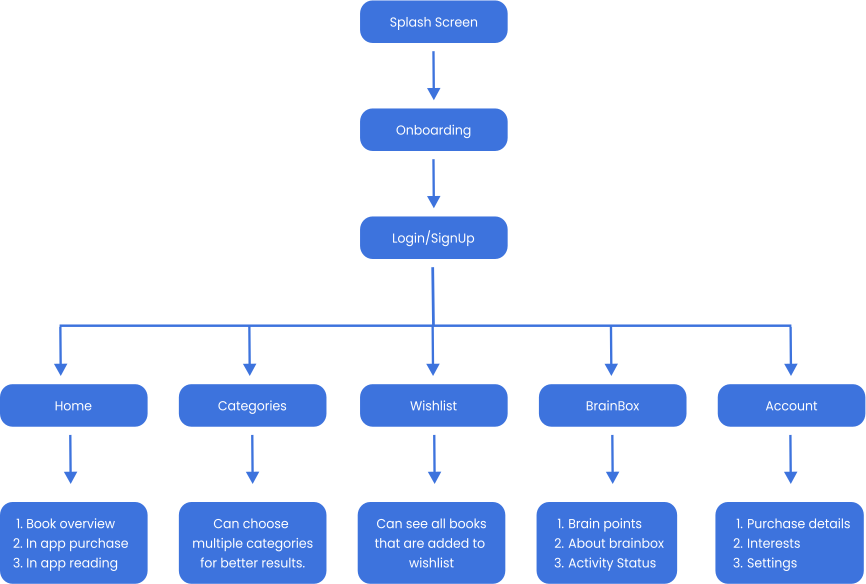
Finally the fruit of our hard work! 🫡
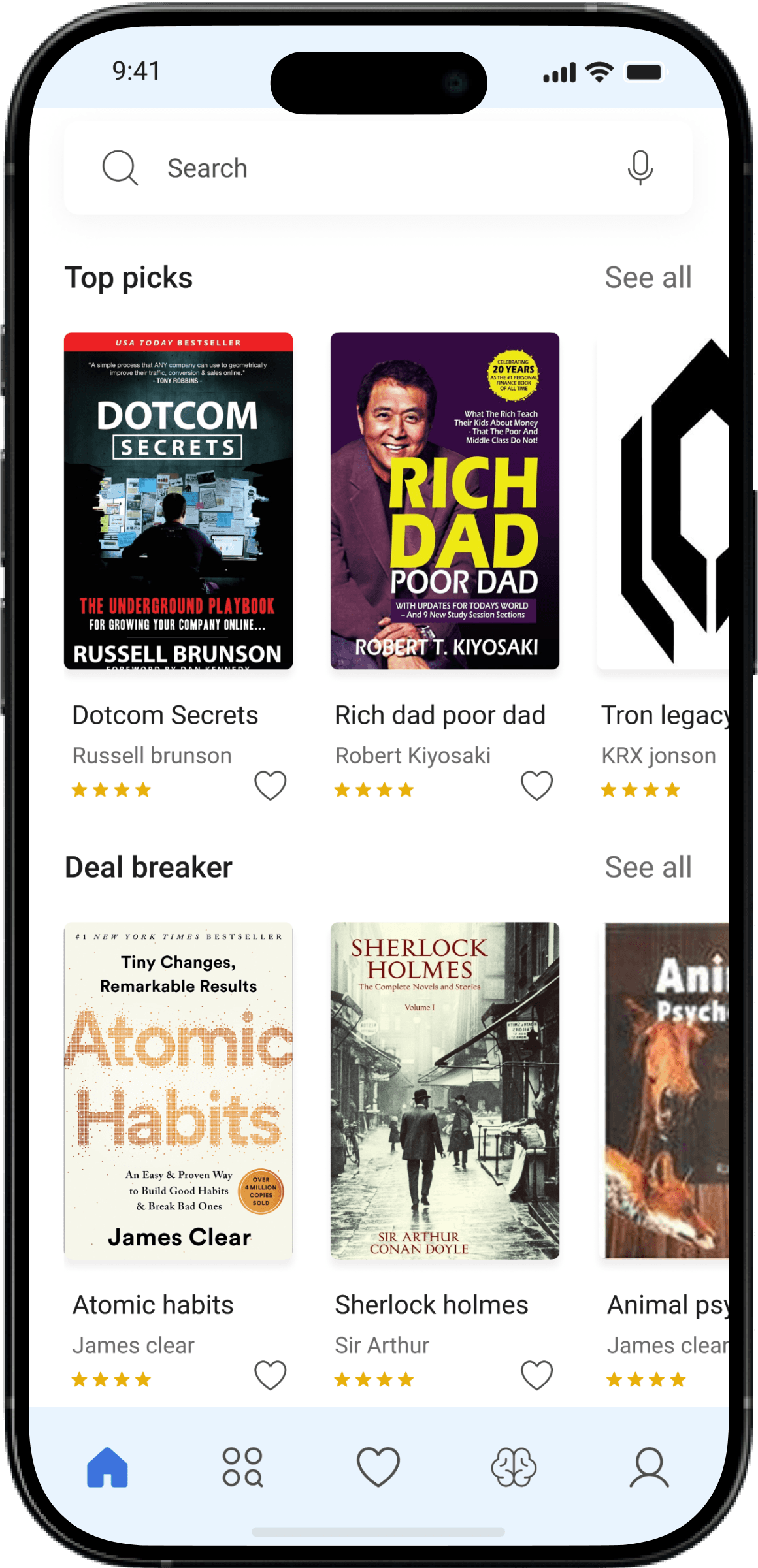
Home
Category
Wishlist
Brainbox
Profile
Validation
The Booktron app not only addressed a critical challenge—helping users build reading habits—but also incorporated innovative gamification and reward mechanisms like Brainbox to drive engagement. The app's success lies in its ability to motivate users through simple, achievable goals and meaningful rewards.
Future scope
1.
Audiobook Integration
Introduce audiobooks for diverse reading formats, enabling seamless transitions between reading and listening. Users can earn Brainpoints for audiobook chapters, catering to multitasking and on-the-go users.
2.
Location Tracking & Smart Notifications
Leverage AI and location tracking to identify user patterns like commutes or downtime and send context-aware prompts for reading or listening.
Learning and conclusion
Through designing Booktron, we learned that users need more than just access to books—they need a system that fosters consistency and provides motivation. By integrating goal-setting features and a rewarding loyalty program, we’ve created an engaging experience that encourages users to form lasting reading habits. This approach not only enhances user retention but also builds a community of motivated readers
Hey you made to the end! Thanks for giving your time if you need to know more about my approach and how I informed and took design decisions, please feel free to reach out to me.😄